


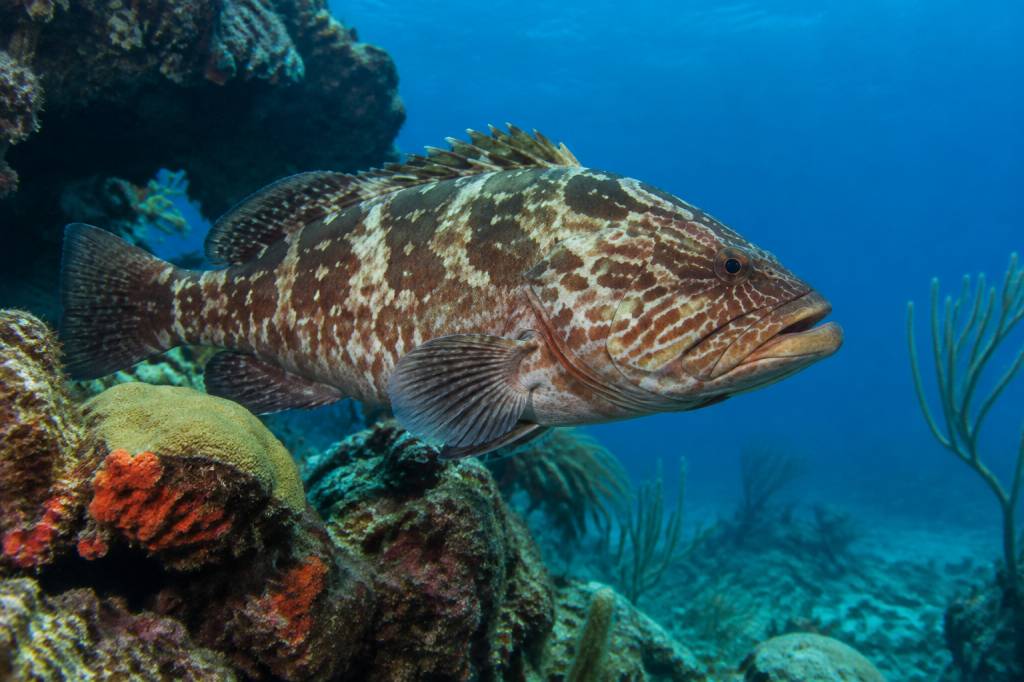
The first time you spot a grouper beneath a reef ledge, it may look less like a fish and more like a very serious rock with fins. Then its eye moves. A mouth opens. And suddenly the “rock” seems to be considering whether you are interesting enough to follow.
Martinique’s warm Caribbean waters are home to several kinds of grouper, from the small, watchful graysby to the impressive Nassau grouper. Learning to tell them apart adds a new layer to a snorkel or dive: the reef becomes a neighborhood, and every shadow might have a name. Here is a practical guide to the groupers you may encounter, what to look for, and how to enjoy the meeting without disturbing the locals.
What makes a grouper a grouper?
Groupers belong to the sea bass family, Serranidae. Many have sturdy bodies, broad mouths and rounded tails. Their colors and patterns are wonderfully varied: spots, stripes, blotches and speckles help them blend into the coral and rock. Some stay close to a hiding place, while others patrol the reef with the composed air of a resident who knows every doorway.
They are ambush predators. Rather than chase every passing fish, a grouper often waits near shelter and strikes when prey comes close. That patient style can make them easy to observe, provided you keep a respectful distance and move slowly.
Color alone is not always a reliable clue. A fish may look darker in a crevice, paler in open water, or more vividly patterned when the light catches it. Size can help, but perspective underwater is notoriously mischievous: a fish that seems enormous may simply be closer to you than you think.
Where to look around Martinique
Groupers favor structure. Search around coral heads, rocky outcrops, reef edges and ledges, especially places with crevices where a fish can disappear with one flick of its tail. You might see one stationed at the entrance to a shelter, peering out as if it is waiting for the reef’s daily news.
Martinique offers a range of underwater settings, from sheltered coastal areas to more exposed reefs. Conditions vary with weather, currents and visibility, so choose a site suited to your experience and check local advice before heading out. Beginners will usually have a better time in calm, protected water than battling a current while trying to identify a fish that has already slipped behind a coral head.
Give yourself time. Floating quietly and scanning the reef is often more rewarding than swimming quickly from one landmark to the next. Look for movement first, then notice the shape, pattern and position of the fish.
The Nassau grouper: a Caribbean classic
The Nassau grouper (Epinephelus striatus) is one of the best-known groupers in the Caribbean. It has a robust body, a broad head and a distinctive pattern that can include dark bars or blotches along its sides. A dark mark near the eye and a prominent saddle-like patch toward the tail can help with identification, although patterns may be less obvious depending on the fish’s color and the light.
Nassau groupers can grow much larger than the small reef species, so an adult may look noticeably solid and substantial. If you see one, watch its outline and markings rather than relying on color alone. It may hold position near a reef shelter, then retreat with impressive speed if startled.
This species has faced serious pressure across the Caribbean, including from fishing and the disruption of spawning aggregations. Its conservation status makes a sighting especially worth appreciating from a distance. Please do not chase, touch or try to corner one for a photograph. A calm fish is a better photograph anyway—and a much better neighbor.
Red hind: spotted, sturdy and easy to admire
The red hind (Epinephelus guttatus) is often recognized by its reddish-brown body covered in small darker spots. Its pattern can resemble a scatter of tiny freckles, which makes it a satisfying fish to identify once you know what to look for.
Red hinds are reef-associated and may be seen near rocky or coral structure. Their compact, substantial build and spotted coloration distinguish them from some of the more elongated groupers. Take a moment to check the whole body: the spots are the giveaway, not simply a reddish tint, which can appear on other fish too.
Like other groupers, red hinds can be cautious. If one ducks into a crevice, pause rather than following it inside. The fish has found a safe place; your best view may come from waiting quietly outside.
Graysby: the small fish with the big expression
The graysby (Cephalopholis cruentata) is a smaller grouper, but it has plenty of character. Look for a compact body with a dark, mottled pattern and small pale spots. Its markings can vary, and its overall appearance may shift with the background, so it is worth looking closely without getting too close.
Graysbies often stay near shelter and may be seen hovering just outside a hole or beneath a ledge. Their alert posture gives them a slightly watchful look, as though they are keeping an eye on reef traffic. Once you spot the first one, you may begin noticing them everywhere—though “everywhere” usually means wherever there is a good hiding place.
Coney: a small grouper in a bright outfit
The coney (Cephalopholis fulva) is another smaller reef grouper, and it can be easier to notice because of its color. Individuals may appear yellowish, reddish or darker, with small blue markings and patterns that can help separate them from other fish.
That variation can make identification tricky. A yellow-looking coney and a red-looking coney may seem like different species at first glance. Look for the fish’s compact shape and the fine blue spots or markings, and compare several features rather than making a decision from color alone.
Conies are often seen around reef structure, where their quick movements and changing appearance suit a life among shifting shadows. They are a lovely reminder that the reef’s smaller residents can be just as fascinating as its larger showstoppers.
Tiger grouper and yellowfin grouper: look for the pattern
The tiger grouper (Mycteroperca tigris) has a more elongated profile than many of the stockier groupers. Its pattern can include dark bars or blotches, creating a striped appearance that gives the species its memorable name. It may be seen around reef slopes and other structured habitats.
The yellowfin grouper (Mycteroperca venenosa) is another species to watch for. Its coloration can vary, but the yellow tones around the fins—especially the tail area—are useful clues. As with all underwater identification, lighting and distance can alter what you see. If the fish turns, check its fins and body shape from more than one angle.
These two species can be harder to identify at a quick glance than a spotted red hind or a small coney. There is no shame in calling one “a grouper, possibly a tiger grouper” in your notes. Underwater naturalists are allowed to leave room for doubt; the fish will not take it personally.
Rock hind and black grouper: two more reef residents
The rock hind (Epinephelus adscensionis) is a sturdy grouper with a patterned body. It may show darker markings or blotches against a lighter background, and its coloring can help it blend into rocky surroundings. Look carefully at its head and body markings, especially when it is holding still near a crevice.
The black grouper (Mycteroperca bonaci) can grow to a much larger size and has a darker, mottled appearance. Its body is more elongated than that of the smaller, compact groupers. A large individual can be an impressive sight, but size alone is not enough for identification; check the pattern, shape and habitat as well.
Both species are best observed without blocking their escape route. If you approach directly, the fish may retreat. A slow, angled approach—and a little patience—often gives you a clearer view.
A quick identification checklist
When a grouper appears, take in the whole scene before trying to name it. These details are especially useful:
-
Body shape: Is it compact and deep-bodied, or longer and more streamlined?
-
Pattern: Look for spots, bars, blotches, pale speckles or blue markings.
-
Fins and tail: Notice their color and shape, particularly if you are considering a yellowfin grouper.
-
Size: Use it as a clue, not proof. Distance underwater can be deceptive.
-
Location: Is the fish tucked under a ledge, hovering by a coral head or moving across an open reef?
-
Behavior: A patient fish near a shelter may be easier to observe than one already swimming away.
If you have an underwater camera, take a photograph from a respectful distance and check the identification later. A clear side view is helpful, but do not pursue a fish to get one. The reef is not a photo studio, and its residents have not agreed to a second take.
Enjoy the encounter responsibly
Groupers are an important part of reef ecosystems, and several Caribbean species have experienced pressure from fishing. Their presence is a reason to admire the reef carefully, not an invitation to handle or feed its wildlife.
-
Keep a comfortable distance and never touch, chase or corner a fish.
-
Avoid standing on coral or gripping reef surfaces for balance.
-
Do not feed fish; it can change their behavior and harm the surrounding ecosystem.
-
Use reef-safe practices, including careful buoyancy when diving and secure equipment when snorkeling.
-
Follow local guidance on protected areas, fishing rules and sea conditions.
Groupers are especially rewarding to watch when they behave naturally. A fish easing out from a shelter, pausing in the blue and disappearing behind coral can be a better memory than any close-up. And if you surface without knowing whether your spotted neighbor was a red hind or a rock hind, that is all right. You have still met one of the reef’s most intriguing residents.
Make room for a little wonder
Once you learn the main clues, a Martinique reef becomes a lively identification game. A dark shape beneath a ledge might be a graysby. A freckled body could belong to a red hind. A larger fish with bars may send you searching your mental field guide for a Nassau or tiger grouper.
Take it slowly, let your eyes adjust to the water, and give each fish the space it needs. The best sightings often happen when you stop trying to make them happen. Then, from the corner of your mask, a pair of watchful eyes appears—and the reef suddenly feels a little less like scenery and a little more like home.