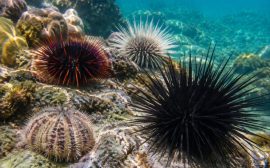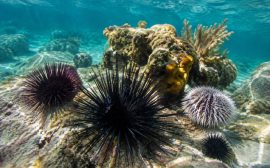
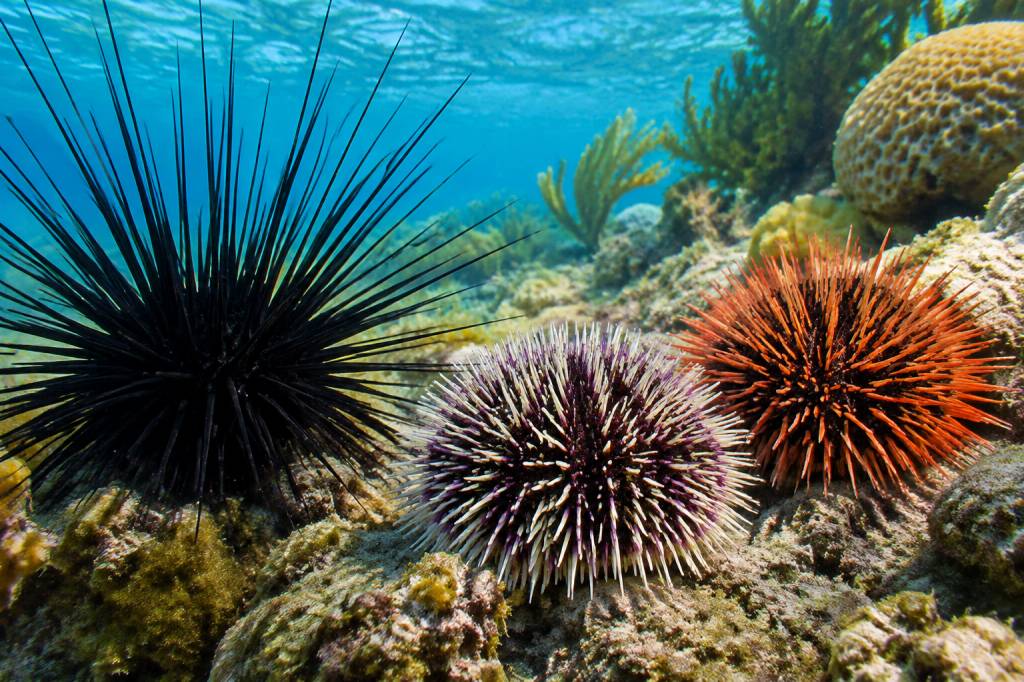
At first glance, a sea urchin can look like a tiny underwater pincushion that has lost a very bad argument with a knitting basket. But pause beside a Martinique reef and you may spot several different kinds: some with long, dramatic spines, others with short, sturdy ones, and a few that look almost too colorful to be real. Their shapes and habits tell a story about the place they live—and about the life unfolding just beneath the surface.
Learning to recognize sea urchins is a lovely way to slow down while snorkeling. The trick is to look without touching: spines can be sharp, and these animals play an important role in keeping coastal habitats healthy. Here’s a guide to the main types you might encounter, where they live, and the clues that help tell them apart.
First, what exactly is a sea urchin?
Sea urchins are marine invertebrates in the echinoderm family, alongside starfish and sea cucumbers. Their rounded body is called a test. It is a hard internal shell made of many small plates, covered in living tissue and moved around on the seafloor by hundreds of tiny tube feet. The tube feet also help the animal grip surfaces, sense its surroundings and, in some species, move food toward its mouth.
Those famous spines are attached to the test by flexible joints. They offer protection, but they’re not the animal’s only defense: some urchins also have tiny pincer-like structures called pedicellariae. Underneath the body is the mouth, equipped with a complex set of teeth known as Aristotle’s lantern. It’s a rather grand name for a tool used to scrape algae from rocks and coral.
That grazing matters. In the right numbers, sea urchins help prevent algae from smothering corals and other reef life. They are not the only guardians of a healthy reef, of course, but they are part of its delicate balance.
Long-spined sea urchins: dramatic, dark and easy to spot
The long-spined sea urchin, Diadema antillarum, is one of the Caribbean’s most recognizable species. Its slender black or dark purple spines can be many times the width of its body, giving it the unmistakable look of a sea creature dressed for a very prickly carnival. You may see it tucked into a reef crevice during the day, with its spines extending out into the light.
Its habitat includes shallow coral reefs and rocky areas, often in places with plenty of algae to graze. The animal’s long spines make identification straightforward, but they also make it especially important to keep a respectful distance. A careless fin kick can turn a peaceful snorkel into a sharp reminder to watch where you’re going.
This species has a significant history in the Caribbean. A devastating disease event in the 1980s caused a dramatic decline across much of its range. Numbers have since recovered in some locations, though not everywhere, and reef scientists continue to study its return. When you spot a long-spined urchin, you’re looking at more than a striking silhouette: you’re seeing an important reef grazer whose story is tied to the health of Caribbean coral ecosystems.
Rock-boring sea urchins: small residents of the shoreline
The rock-boring sea urchin, Echinometra lucunter, is common around rocky shores and reef flats in the tropical western Atlantic, including the Caribbean. It is usually smaller and more compact than Diadema, with shorter, blunt-tipped spines that may look dark, reddish or purplish depending on the animal and the light.
Its name is a useful clue to its lifestyle. By grazing and rubbing against rock over time, it can help create shallow hollows that offer shelter. Look in rock crevices and pools where waves wash over the shore. From above, the urchin may seem like a dark, spiky dot in a pocket of stone. At a glance, it can be easy to overlook—but that does not make it a good handhold. Bare feet, curious fingers and sea urchins are not a happy trio.
Rock-boring urchins are sometimes confused with other small dark species. Focus on the setting as well as the shape: a compact urchin nestled into a rocky hollow is a different sight from the much more open, long-spined form of Diadema.
West Indian sea eggs: round, colorful and a little shy
The West Indian sea egg, Tripneustes ventricosus, has a much softer-looking appearance than the long-spined species. Its body is rounded, with short spines that may be white, pale green, brown or purple. The colors can vary, so don’t expect every individual to match the neat picture in a guidebook.
It lives in shallow tropical waters, including seagrass beds, sandy areas and reef habitats. Sea eggs often shelter beneath pieces of seagrass, algae or other material, a sort of underwater sun hat that helps camouflage them. If you spot one, look for the rounded outline and relatively short spines rather than the dramatic needles of Diadema.
Sea eggs are eaten in parts of the Caribbean, and their roe is valued in some local food traditions. That does not mean a visitor should collect one: harvesting rules can vary, and marine life is best left where it belongs unless you have checked local regulations and know what you’re doing. Admiring a sea egg in its seagrass bed is a wonderfully low-impact way to enjoy the encounter—and it won’t require a recipe.
Variegated sea urchins: green shades in the seagrass
The variegated sea urchin, Lytechinus variegatus, is another species associated with warm western Atlantic waters. Its color can range from green to purple or reddish tones, often with a mottled appearance. The spines are shorter than those of Diadema, and the body can seem smoother and more rounded from a distance.
Look for it in shallow seagrass beds and sandy habitats, where it feeds on vegetation and algae. Seagrass meadows may not have the instant postcard drama of a coral reef, but they are busy, beautiful places: young fish shelter there, turtles forage, and small invertebrates live among the blades. A sea urchin moving through the grass is part of that quiet neighborhood.
Color alone is not a reliable way to identify this species. Sunlight, depth, the color of nearby plants and the animal’s own variation can all change what you see. Notice the overall shape, spine length and habitat together. Underwater identification is a little like meeting someone in a dimly lit café: one clue rarely tells the whole story.
Slate-pencil urchins: sturdy spines and an ancient look
The slate-pencil urchin, Eucidaris tribuloides, has stout, blunt spines that look more like little clubs than needles. Its body may be reddish or brown, and its chunky spines give it a distinctive, almost prehistoric appearance. It is found in the western Atlantic and Caribbean, often on reefs and rocky bottoms.
Unlike the fine, sweeping spines of Diadema, the slate-pencil urchin’s armor is thick and solid-looking. It may sit among coral rubble or under ledges, where its coloring helps it blend in. The name is also a handy memory aid: imagine a sea urchin carrying a bundle of tiny pencils. Not the most efficient school supply, perhaps, but a memorable one.
As with any urchin, avoid picking it up. Even a species with blunt-looking spines is a living animal, and handling can injure it or disturb the delicate habitat around it.
How to identify a sea urchin underwater
When you’re floating above a reef or rocky shore, you may have only a few seconds to notice what you’re seeing. Keep your movements calm and use a combination of clues rather than relying on color alone.
- Check the spine length. Very long, fine spines suggest Diadema antillarum. Shorter, thicker spines point toward species such as Echinometra, Tripneustes or Eucidaris.
- Notice the shape. A rounded body with short spines may belong to a sea egg or variegated urchin; a compact animal in a rock hollow may be a rock-boring urchin.
- Look at the habitat. Reefs, rocky pools, sandy patches and seagrass beds each attract different species. Habitat narrows down the possibilities, though it does not prove an identification.
- Observe the posture. Some urchins sit exposed on rock, while others shelter beneath seagrass or inside crevices. A covering of plant material can be camouflage, not debris.
- Give color a supporting role. Color varies naturally and changes with the light. Use it alongside size, shape, spines and location.
If you’re unsure, take a photo from a safe distance and compare it later with a reputable marine-life guide. There’s no need to chase an animal for a better view; a sea urchin is not going to pose on command, and frankly, neither would I.
Where you might see them around Martinique
Martinique’s warm coastal waters offer a variety of habitats, from coral reefs and rocky shorelines to sandy bottoms and seagrass meadows. Sea urchins are most easily spotted when the water is clear and the sun is high enough to illuminate the seabed. Snorkeling slowly near a reef or looking into a calm rock pool can reveal much more than swimming quickly from one beach to another.
Conditions change with weather, waves and visibility, so sightings are never guaranteed. Choose a calm, permitted snorkeling area, check local advice before entering the water, and avoid standing on coral or seagrass. A good pair of well-fitting fins helps you stay balanced without kicking the bottom. If you’re snorkeling with a guide, ask them to point out the differences between species; local knowledge can turn a quick swim into a miniature natural-history lesson.
Enjoy the encounter without getting hurt
Sea urchins are easy to admire and surprisingly easy to disturb. Never step on, touch or collect one. Their spines can break in the skin, and attempting to remove embedded pieces without proper advice may make things worse. If you are injured, leave the water, seek appropriate medical assistance and follow local guidance rather than relying on a home remedy found in a comment thread.
- Wear suitable footwear when walking over rocky shorelines, but remember that footwear is not a reason to step on marine life.
- Keep a comfortable distance while snorkeling and avoid reaching into crevices.
- Do not stand on coral, rocks covered in life or seagrass beds.
- Never collect sea urchins or other marine animals without checking the rules and having a legitimate reason.
- Take photos, not souvenirs. The best memory is one that leaves the reef exactly as you found it.
Once you know what to look for, sea urchins become more than spiky shapes beneath the water. A long-spined Diadema guarding a reef crevice, a small rock-borer tucked into stone or a green sea egg hidden in seagrass each belongs to a different underwater scene. On your next Martinique swim, take a slower route and let your eyes adjust. The reef has plenty to show you—provided you give its prickliest residents room to be themselves.